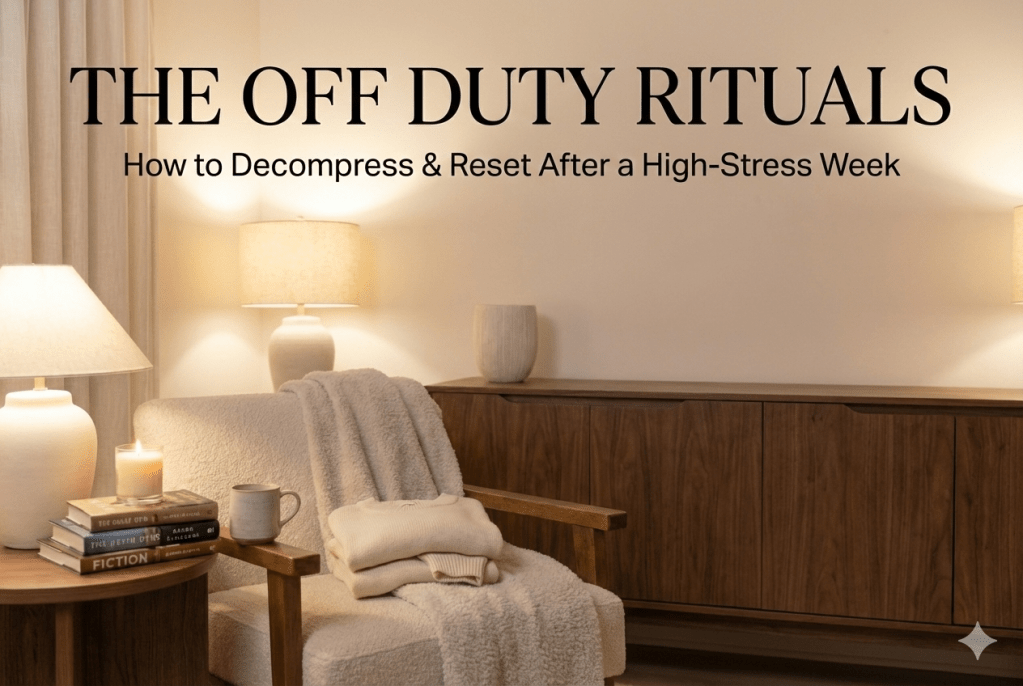
How to Decompress & Reset After a High-Stress Week
By Nilah Ahimsadasan
We glorify the hustle. We track our hours, our steps, and our productivity. But as a medical student, I’ve learned the hard way that if you don’t schedule your restoration just as rigorously as your rotations, you will burn out.
Closing the door on a high-stress week requires more than just collapsing onto the couch with Netflix. It requires an active shift in mindset—a ritual that signals to your brain that being “on duty” has officially ended.
If you are carrying the weight of the week on your shoulders right now, here is my personal edit for an intentional, restorative Friday evening reset.
1. The Sensory Shift: Lighting and Scent
Hospitals and offices are defined by fluorescent lights and sterile smells. Your off-duty space needs to be the exact opposite.
The minute I walk in the door, the “big lights” go off. I switch to low-level lamps with warm-toned bulbs. Next, I light a candle. Scent is incredibly powerful for shifting mindset. I look for notes of sandalwood, amber, or lavender—anything that feels grounding and cozy, signaling to my nervous system that it’s safe to unclench.
2. The “Soft Uniform” Change
We’ve talked about the importance of the work uniform, but the post-work uniform is just as crucial. You need to physically shed the layers of the day.
Get out of those scrubs or tailored trousers immediately. My current ritual involves changing into a matching knit lounge set. There is something about the texture of cashmere, wool, or soft cotton against the skin that feels like a physical exhale. It’s comfort, but elevated.
3. The Analog Escape
Our jobs demand constant digital input—pagers, emails, electronic records. Your reset requires an analog break.
For the first hour of my evening, my phone goes into another room on silent. Instead, I turn to something tangible. A physical book (fiction is best for true escapism), a journal, or even just staring into the flame of that candle you lit. Give your eyes and your brain a break from the blue light.
4. The Warm Pause
Before worrying about dinner, I take ten minutes for a “warm pause.” This is usually a ceramic mug filled with herbal tea (peppermint or chamomile) or perhaps hot cocoa if it’s been a particularly brutal week.
Don’t multitask while you drink it. Just sit. Feel the warmth of the mug in your hands. It’s a small act of mindfulness that bridges the gap between the chaos of the workday and the peace of the evening.
 Off Duty Edit
Leave a comment